If you're having trouble viewing this email, you cansee it online.
July 2026
Dear {{Preferred Name/First Name}},
It is the deep part of summer in Alabama, when the heat settles in early and the work doesn't slow down for it. This time of year has us thinking about the soil itself and about the long line of farmers who worked to keep it healthy.
Regenerative agriculture is in the news a lot these days and it can sound like something brand new, but it's not. The term was coined by the Rodale Institute in the 1980s, but the practices behind it are older than that. Long before Europeans arrived, Native peoples were intercropping and using fire to keep land productive. As settlers displaced Native communities and brought the plow, that knowledge was largely lost, and the land was pushed past what it could give. When the Dust Bowl stripped the plains, it was clear that care for the soil was not optional, and the response became what we now know as the Natural Resources Conservation Service.
Alabama has its own place in that story. George Washington Carver, who farmed and taught in Tuskegee, called it "being kind to the soil." On land worn out by years of cotton, he taught farmers across the South to rotate their crops and plant peanuts, cowpeas, and sweet potatoes to pull nitrogen back into the ground, and to feed the soil with compost and swamp muck instead of buying costly chemicals. Much of what we now call regenerative agriculture traces straight back to that work.
That's the tradition ASAN has been part of since 2001. Our aim has always been a resilient, regenerative farm and food system in Alabama, built on healthy soil, healthy water, and farms that can make a living. It shows up in the on-farm trainings we host through our CRAFT Network, where farmers learn from one another on everything from cover crops to grazing. Carver's kindness to the soil is still the thread that ties this whole network together.
That thread is also pulling us forward. This year we formed a Policy Steering Committee, a group of farmers and policy experts helping shape where ASAN stands on the issues that affect your livelihood. It's a real step, but a committee can only carry us so far. To do the day-to-day work of changing policy, we need a presence where the decisions get made. We're working toward placing a policy director in Montgomery, someone who can show up at the statehouse, build relationships with lawmakers, and keep Alabama's small and mid-scale farmers in the room instead of just talked about.
We're also thinking hard about who farms next. We want to see Alabama farmland stay in production, but the way into farming is steep for anyone without a family farm to inherit, and not every farm family has children who want to carry it on. So we're building a land access resource to connect retiring farmers with beginning farmers, so that good ground and the knowledge that comes with it gets passed on rather than paved over.
None of this happens without you. The work ahead depends on people who believe Alabama farmland and farm families are worth standing up for, whether that's a policy director in Montgomery, a land access program, or more trainings across the state. If that's you, we're grateful for your support.
Thank you for being part of this work. We're glad you're here.
Rooted in Alabama,
Alan and Rachel
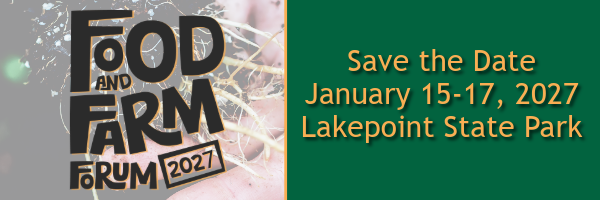
If you would like to be an exhibitor, sponsor, or presenter at Alabama's premier statewide gathering built for and by sustainable producers, then email [email protected] for more information. We're excited to host the next Food & Farm Forum in the Black Belt region and we can't wait to see you there!
An Annotated Bibliography on Structural Racism Present in the U.S. Food System—Researchers at Michigan State University's Center for Regional Food Systems look back on a decade of compiling the research, outreach, and opinion on structural racism in our food system. The essay traces how their own understanding of racial equity grew over that time, and points to where the work still needs to go. It is a thoughtful read for anyone thinking about who gets to farm and who gets left out.
Egg producers to pay $3.3M and donate 53 million eggs to settle price-fixing claims—The Justice Department and 17 states settled with three major egg producers over allegations they colluded to inflate egg prices from 2022 to 2025. The companies admit no wrongdoing but will pay $3.3 million, donate 53 million eggs to food banks, and adopt antitrust compliance programs.
John Deere reaches right-to-repair settlement with FTC—John Deere reached a proposed settlement with the FTC and five state attorneys general that would give farmers and independent repair shops the same diagnostic software, tools, and manuals that authorized dealers get. It follows a separate $99 million class-action settlement with farmers over similar claims.
Farmer Spotlight
This month, our Farmer Spotlight is on Dr. Dana Nettles! Dr. Nettles is a licensed pharmacist and has been actively practicing for the last 30 years. Her pharmaceutical practice and passion for holistic medicine led her to co-found Dr. Nettles Natural Beauty LLC. All of the products sold by Dr. Nettles Natural Beauty are grown on the family-owned organic farm. A dedicated ASAN member and pioneer in growing certified organic in Alabama, Dr. Nettles has been an amazing example of how agriculture, medicine, and health intersect. Click here if you would like to learn more about Dr. Nettles' work.
Undo the Knot Fund
Mini-grants for ASAN farmer members facing hardship, such as production setbacks, transition costs, unexpected inputs, natural disasters, or medical debt.
We send volunteers to ASAN member farms when the work is bigger than the labor available, pretty much anything that needs more hands than a small operation can spare.
Consider Your FSA County Committee:These committees make real decisions about how federal farm programs run in your county, and elections are underway now. Nominations close August 3.
Tell Your Senator What a Real Farm Bill Looks Like: Call SenatorsTuberville andBritt and tell them, in your own words, what a Farm Bill needs to do for your operation and your community. A two-minute phone call from a working Alabama farmer matters more than you'd think. U.S. Capitol Switchboard: (202) 224-3121
Has an ASAN Program Changed the Way You Farm? If something you picked up at a Food and Farm Forum, CRAFT field day, or another ASAN event has shifted something on your operation, big or small, we want to hear about it from you. We've got grant funding to document the real impact of our programs, which means we'll come visit and we'll pay you for your time. Reach out by the end of July at [email protected] or (256) 743-0742.
New World Screwworm has turned up in animals in Texas and New Mexico, the first U.S. cases in nearly sixty years. It's not in Alabama and it is not a food safety issue, but watch for wounds that will not heal or fill with maggots, and call the State Veterinarian's office at 334-240-7253 if something looks wrong.
Share a Win for Land Access: A federal court has ordered USDA to restore $127 million in canceled grants under the Increasing Land, Capital, and Market Access (LCM) program, reinstating agreements for 24 organizations and local governments. This is the kind of program that helps beginning and limited-resource farmers get onto land. Help spread the word.
Join a statewide community of farmers, advocates, and food system changemakers. Member benefits include discounts, online member forum access, grant eligibility, and a voice in ASAN's direction.
Not ready to become a member?You can still support ASAN’s mission by making a recurring or one-time donation. Every dollar helps build a stronger, more sustainable food system for us all.
Alabama Farm Service Agency Producer Exposition—Open to all farmers and producers. Vendors, information booths, and a talk from Alabama State Climatologist Dr. Lee Ellenburg on current drought conditions and assistance options. FSA staff from Calhoun, Chambers, Cherokee, Clay, Cleburne, Coosa, DeKalb, and Elmore counties will be on site. July 21st, 10AM–2:30PM, Oxford Civic Center, 401 McCullars Ln, Oxford, AL.
Webinar: Growing Landscape of Statewide Local Food Solicitations—Hosted by National Farm to School Network, this webinar will cover how states are using statewide or regional food solicitations to make local food purchasing easier for schools. July 23rd, 1:00PM–2:15PM.
Elderberry Production and Pest Management Workshop on August 11 at 10am in Huntsville will feature Extension professionals discussing elderberry production and pest management strategies, a grower talk from Elder Farms in Missouri, and a tour of the small research planting at Alabama A&M.
Commercial Strawberry 101 class on August 20 at 5:30pm in Hartselle will cover the building blocks of growing strawberries on the farm or market garden: cultivars, production systems, pest management, and marketing.
South Alabama Sustainable Farmers Forum—ASAN's Central Alabama Forum last month was a day of fellowship and learning, with sessions on market opportunities, agricultural policy, and fruit production. We are bringing that same spirit south on September 18 in Headland, at the Wiregrass Research and Extension Center. The event is free, but registration is required, and lunch will be provided. To inquire about exhibiting or presenting, email [email protected].
8th Annual Alabama Honey Bee Festival is an outdoor educational event and market with vendors that support bees and pollinators. It will take place at Alabama A&M University's Winfred Thomas Agricultural Research Station in Hazel Green, AL on October 4th, 1PM–5PM. Potential vendors can complete this form.
Healthy Food Financing Initiative FARE Fund—Grants and technical assistance for fresh, healthy food retailers and post-harvest retail supply chain enterprises working to improve healthy food access in underserved areas. Grants $20,000 to $250,000 plus up to $75,000 in technical assistance per project. Inquiry due July 31st.
For Farmers Grant—Flexible funding for farmers to cover equipment, infrastructure, repairs, safety improvements, losses, or other farm priorities. Awards run $500 to $1,000, with a chance to apply for $5,000 or $10,000. Open to producers nationally. Apply by October 12th, with bonus points for applying early.
Meat and Poultry Processing Expansion Program (MPEPP)—$60 million for very small, small, and intermediate meat and poultry processors. Processing expansion projects $50K to $2M; equipment-only projects $10K to $250K. Apply by August 7th.
Expanding Agroforestry Project—Support for farmers adopting or expanding agroforestry, aimed at improving profitability. Incentive payments vary by project. Apply by August 11th.
National, Youth, and Breed Association MicroGrants—Funding to support U.S. residents and organizations working with livestock and poultry breeds listed on The Livestock Conservancy's Conservation Priority List. Awards range from $500 to $2,000. Applications due August 15th.
Irrigation Funding—for On-farm Trial participation GreenSky Gives is enrolling eligible farmers, ranchers, and landowners in Alabama, Florida, and Tennessee for irrigation improvements for on-farm trial participation. Open now, first come first serve, expected to stay open through September.
Tribal Colleges Research Grants Program(USDA NIFA)—Research capacity grants for the 35 designated 1994 Land-Grant Tribal Colleges in agriculture, natural resources, and human sciences, with priority on projects using AI, data science, and robotics. Eligibility is limited to the listed Tribal colleges (none in Alabama); application closes December 31st.
Organic Certification Cost Share—USDA Farm Service Agency county offices are now taking organic certification cost share applications for both 2025 and 2026. This reimburses a share of what it costs to get and keep organic certification. Apply through your local FSA county office. Applications accepted until December 31st.
On-Farm Labor Housing Loans—Low-interest USDA financing for farm owners and farmer groups to build or fix up affordable rental housing for farmworkers. Loans up to $5 million. Open until funds are used up.
Livestock Forage Disaster Program (LFP)pays Alabama livestock producers in eligible counties for grazing losses caused by drought or fire. Award amounts vary, apply by March 1, 2027.
Community Facilities Direct Loan &Grant:This program provides affordable funding to develop essential community facilities in rural areas. Local food systems such as community gardens, food pantries, community kitchens, food banks, food hubs or greenhouses qualify for this funding. Applications are open year round.
Tax Exemption Opportunity:Fencing materials, such as t-posts, wood posts, barbed wire, net wire, smooth wire, standard metal gates, and other like materials used for the purpose of fencing in agriculture livestock applications are exempt from state sales and use taxes through September 30, 2029. To benefit, the purchaser must provide the retailer with Form ST:EXC-2. For more information, email[email protected].
SERVICES
HATCH For Hunger:A program that connects meat, egg, and dairy producers with hunger relief organizations, helping food banks get consistent protein at lower, more predictable cost. Worth a look for producers who want to move product while feeding their community.
Organic Compost: Aged Horse Manure. Auburn Analyzed. Persistent Herbicide Free. $20 per tractor scoop. 2 scoops = 1 yard. Located in Shelby County on Hwy 47, Chelsea/Columbiana area at James Hale Stables.
JOBS & APPRENTICESHIPS
Farm Outreach Coordinator—Connect fresh produce with neighbors in need and support local farmers with conservation resources at the North Alabama Agriplex. Runs the gleaning program, promotes NRCS resources, and supports farmers markets. Full job description and application instructions are linked in the job title.
School Programs Educator—Lead hands-on, curriculum-based programs at North Alabama schools and field trips at the North Alabama Agriplex. Full job description and application instructions are linked in the job title.
Communications Coordinator—Share the North Alabama Agriplex mission through social media, events, and fundraising, and help coordinate volunteers and the Power of Produce program. Full job description and application instructions are linked in the job title.
EDUCATION & TRAINING
Advancing Regional Organic Markets: A Farmer's Toolkit (Southeast)—Updated since its December 2025 launch, designed to help farmers and supply-chain partners identify market opportunities for high-demand organic crops, reduce reliance on imports, and build stronger regional connections between growers, processors, and buyers.
Land Ethic Mentorship—A free program that pairs beginning, veteran, and historically underserved farmers and ranchers with experienced conservation mentors, including Sand County Foundation's Leopold Conservation Award recipients, to help navigate USDA conservation programs and practices. Mentees also get access to field days and webinars, and there is an Alabama farmer cohort.
Preparing for the Traceability Rule—A plain language guide, video modules, and a written deep dive to help farmers understand the FDA traceability rule expected to take effect in 2028, which will require documentation for certain high risk foods from field to fork.
RESEARCH & CONSERVATION
Participants Needed for an IRB-approved doctoral research study at Saint Leo University examining the success factors of small agricultural businesses in the Southeast. Individuals who have transitioned from hobby-level farming or homesteading into income-generating agricultural operations are invited to participate in a confidential interview; please contact LaTanya Lewis at [email protected].edu for additional information.
Great Southeast Pollinator Census is a University of Georgia Project open to residents of Alabama, Florida, Georgia, Mississippi, and the Carolinas. This citizen science project invites gardeners, students, and farmers to count and identify pollinators in order to build entomological literacy and generate useful data on pollinator population trends across the region. August 21 & 22.
.png)

.jpg)


.png)


