If you're having trouble viewing this email, you cansee it online.
August 2026
Dear {{Preferred Name/First Name}},
ASAN staff just returned from the National Sustainable Agriculture Coalition summer meeting, where we worked with partners from across the country to strategize equitable and sustainable federal farm and food policy. While we were there, the Senate Agriculture Committee took up the farm bill for markup.
While a bipartisan amendment secured meaningful funding to open up local markets for farmers, the bill still falls short of what Alabama farmers need. For now, the farm bill failed to pass along party lines and the committee can take it back up in September, so there is still time to shape it.
As a member of the Senate Agriculture Committee, we reached out to Senator Tuberville's office to ensure he knew that Alabama farmers need:
Conservation programs farmers can actually get into. Every year more farmers apply for programs like EQIP and CSP than there is money to fund, and many are turned away. In 2025, only 37% of Alabama EQIP applications and 19% of CSP applications got a contract, and the Senate bill cuts these programs further.
Reliable investment in local food. Last year Alabama lost nearly $6 million in Local Food Purchase Agreement support and $10.5 million in Local Food for Schools support, cutting off markets that farmers and schools were counting on. 69% of those LFPA dollars had gone to socially disadvantaged farmers.
A safety net that fits diversified operations. Only 7.4% of Alabama farms carry crop insurance, which tells you the current system was not built for the kind of farming much of our state does. In fact, when we met with the offices of Tuberville, Britt, and Moore back in February, none of them knew that most Alabama farmers do not qualify for crop insurance.
We will keep you posted as chances to strengthen the bill come up. If you want to be part of this work, our Policy Steering Committee would be glad to have you.
Rooted in Alabama,
Alan, Rachel, and the ASAN Policy Steering Committee
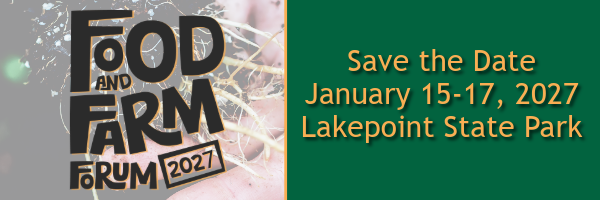
If you would like to be an exhibitor, sponsor, or presenter at Alabama's premier statewide gathering built for and by sustainable producers, then email [email protected] for more information. We're excited to host the next Food & Farm Forum in the Black Belt region and we can't wait to see you there!
It’s Time to be ‘Alabama Honest’ About SNAP Cuts—A new federal law ends the guarantee that Washington pays for SNAP food benefits and starts pushing part of the cost onto the states. Alabama's own SNAP director has laid out three options: find the money, cut the state's error rate below 6%, or end the program. This article looks at what that could mean here at home, including the nearly half of Alabama's 752 SNAP retailers who could be hit hard and the 117 stores that may be at risk of closing, many of them in the rural communities that already have the fewest places to buy groceries.
Breaking the Cycles of Co-optation—John Ikerd, professor emeritus of agricultural economics at the University of Missouri, traces how each wave of farmer-led reform, from organics to sustainable to local to regenerative, has been quietly absorbed and watered down by industrial agriculture. His new column in the Journal of Agriculture, Food Systems, and Community Development asks whether "resilient agriculture" is next in line, and what it would take to hold onto its meaning.
Farmer Spotlight
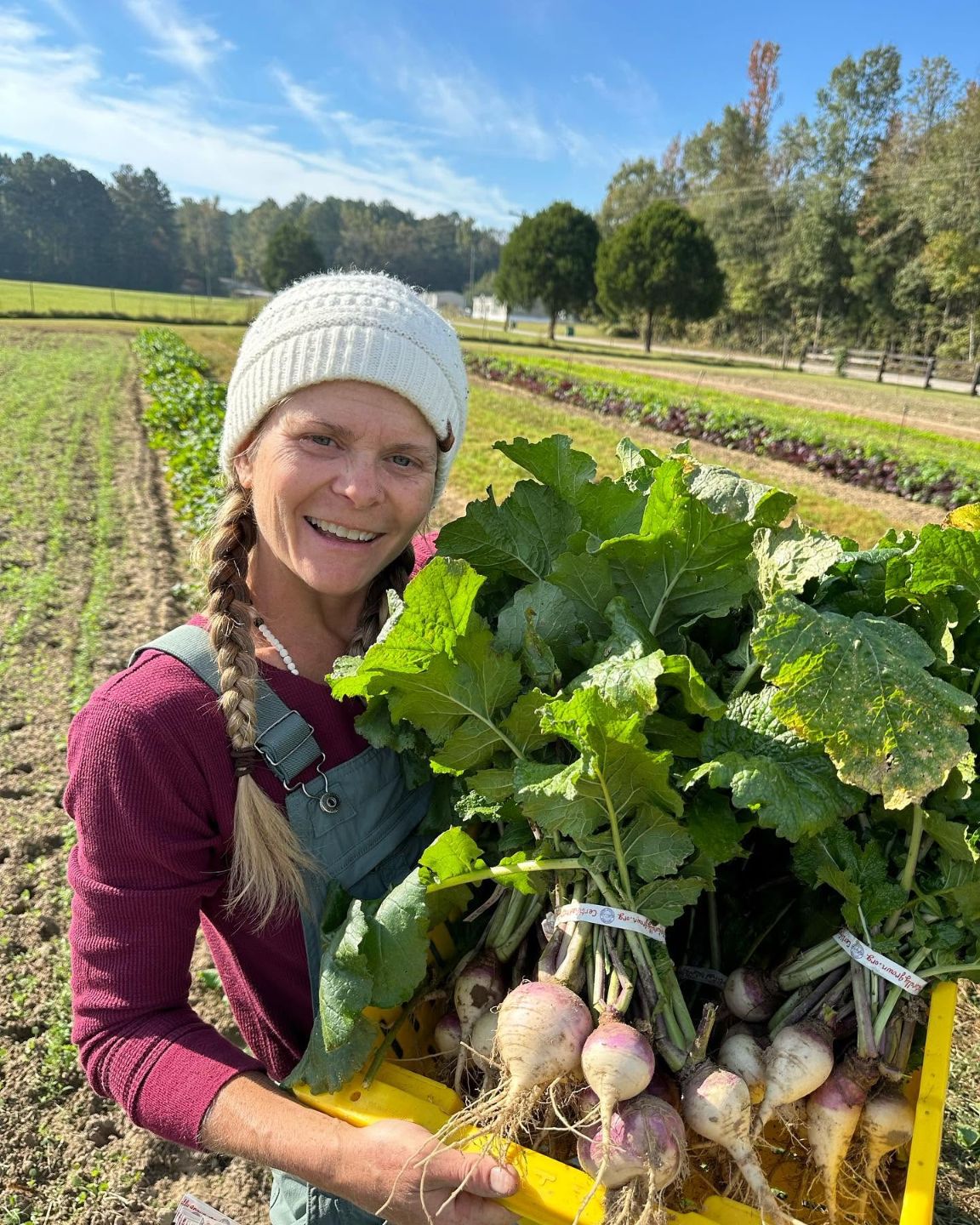
This month we are highlighting Jennifer Dunbar, owner and operator of Lovelight Farms. As a Certified Naturally Grown market farm, Lovelight is dedicated to providing clean, nutrient-dense food to Central Alabama. Lovelight Farms is also an epicenter for food education by partnering with local schools to host projects and on-farm experiences. You can purchase from Lovelight at the weekly Pepper Place Farmers Market or by joining their CSA program. If you're interested in learning more about Jennifer and Lovelight Farms, watch our Farm Operations Tour here.
Undo the Knot Fund
Mini-grants for ASAN farmer members facing hardship, such as production setbacks, transition costs, unexpected inputs, natural disasters, or medical debt.
We send volunteers to ASAN member farms when the work is bigger than the labor available, pretty much anything that needs more hands than a small operation can spare.
Help Spread the Word: Food for Public Good Collaborative has just launched a new website for local governments to share and collaborate on values-based food procurement. This Collaborative is housed at Partners for Public Good, a nonpartisan, non-profit that focuses on making government work for its people. The peer learning network engages city and county staff who are supporting government food programs, such as public schools, hospitals, senior centers, and jails, to purchase food that invests in public health, environmental sustainability, and local economies.
Grassroots Guide to Federal Farm and Food Policy: National Sustainable Agriculture Coalition's guide provides an in-depth look at dozens of federal programs and policies most important to sustainable agriculture, and details how they can be accessed by farmers, ranchers, and grassroots organizations nationwide.
Join a statewide community of farmers, advocates, and food system changemakers. Member benefits include discounts, online member forum access, grant eligibility, and a voice in ASAN's direction.
Not ready to become a member?You can still support ASAN’s mission by making a recurring or one-time donation. Every dollar helps build a stronger, more sustainable food system for us all.
Monthly ASAN Office Hours—Beginning Thursday, September 3rd, join ASAN staff, board and committee members, farmers, and local food advocates to network, learn more about ASAN's direction, and help guide our priorities. All are welcome, come and go as you please. For now, we'll host this ongoing monthly virtual meeting every 3rd Thursday from 11:30AM-12:30PM. We'll likely shift to an earlier "coffee hour" in the winter.
Commercial Strawberry 101—class on August 20 at 5:30pm in Hartselle will cover the building blocks of growing strawberries on the farm or market garden: cultivars, production systems, pest management, and marketing.
10th Annual Harvest to Home Local Foods Dinner—A farm-to-table dinner and auction benefiting the North Alabama Agriplex and its farm education work. Thursday, August 27, 2026, doors at 5 p.m., dinner at 6 p.m. The Venue at Cotton Creek, 417 3rd Ave SW, Cullman. Tickets are $50 per person or $500 for a table of eight.
CRAFT: Principles of Permaculture for Organic Farmers—Join us at EcoRidge Farm in Collinsville for a gathering on nature-inspired design and how permaculture principles can work on an organic farm. We will learn practical ways to build systems that work with nature rather than against it. Bring your questions and your own experience. September 10th, 11AM-2PM.
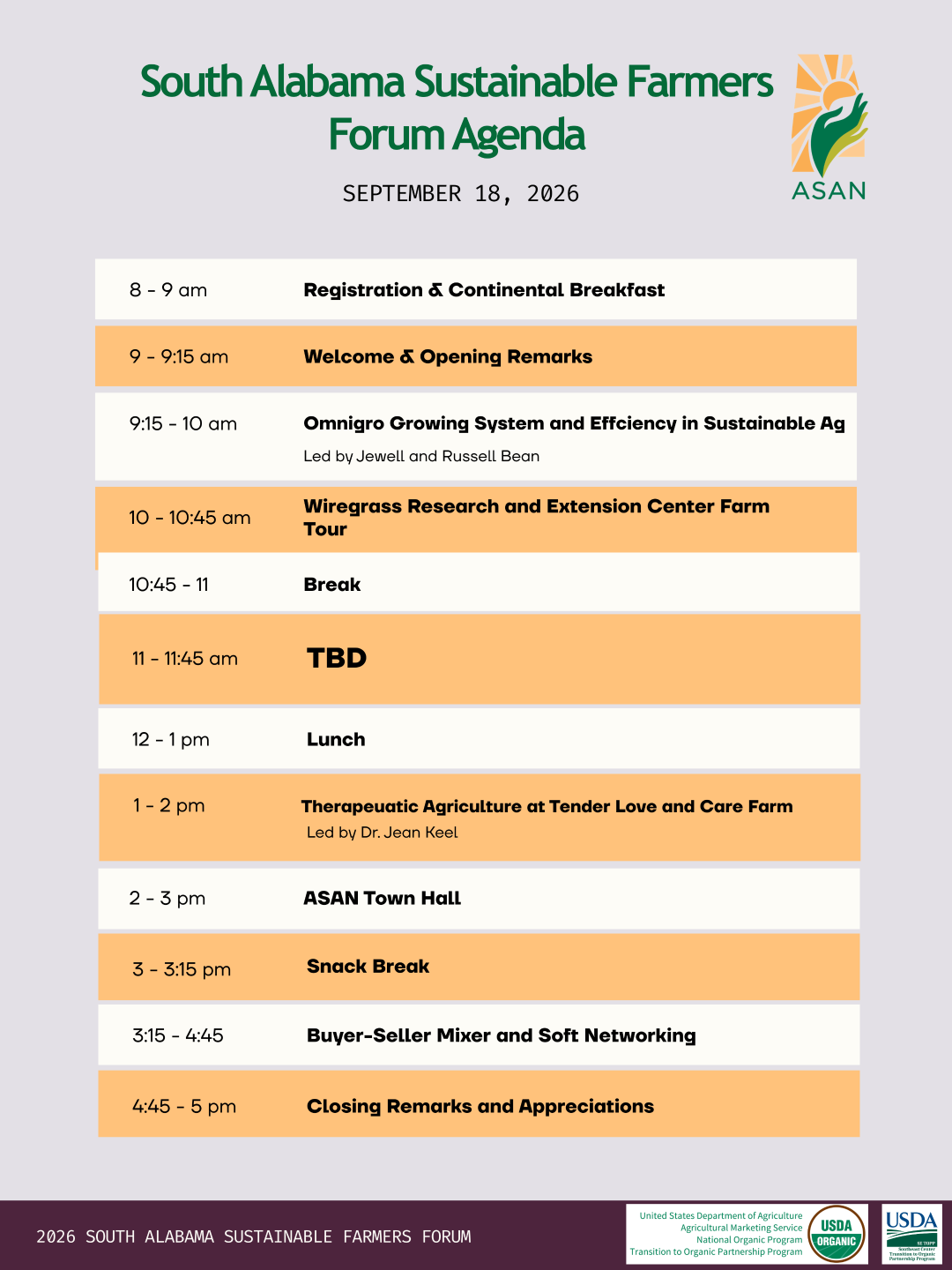
South Alabama Sustainable Farmers Forum—ASAN's Central Alabama Forum was a day of fellowship and learning, with sessions on market opportunities, agricultural policy, and fruit production. We are bringing that same spirit south on September 18 in Headland, at the Wiregrass Research and Extension Center. The event is free, but registration is required, and lunch will be provided. To inquire about exhibiting or presenting, email [email protected].
CRAFT Webinar: Organic Produce to Market—Growing it is half the story. Selling it is the rest. Join us online for a CRAFT webinar on getting your organic produce to market, from finding the right buyers to pricing your harvest and building relationships that last. Come with your questions about the business side of farming. September 22nd, 5PM-6PM.
8th Annual Alabama Honey Bee Festival is an outdoor educational event and market with vendors that support bees and pollinators. It will take place at Alabama A&M University's Winfred Thomas Agricultural Research Station in Hazel Green, AL on October 4th, 1PM–5PM. Potential vendors can complete this form.
For Farmers Grant—Flexible funding for farmers to cover equipment, infrastructure, repairs, safety improvements, losses, or other farm priorities. Awards run $500 to $1,000, with a chance to apply for $5,000 or $10,000. Open to producers nationally. Apply by October 12th, with bonus points for applying early.
Irrigation Funding—for On-farm Trial participation GreenSky Gives is enrolling eligible farmers, ranchers, and landowners in Alabama, Florida, and Tennessee for irrigation improvements for on-farm trial participation. Open now, first come first serve, expected to stay open through September.
Feral Swine Eradication and Control Pilot Program—$35 million available for partnerships that control feral swine, restore damaged farmland, help landowners, and provide trapping and related training. Geared toward organizations and partnerships rather than individual farmers. Apply by September 21st.
Tribal Colleges Research Grants Program(USDA NIFA)—Research capacity grants for the 35 designated 1994 Land-Grant Tribal Colleges in agriculture, natural resources, and human sciences, with priority on projects using AI, data science, and robotics. Eligibility is limited to the listed Tribal colleges (none in Alabama); application closes December 31st.
Organic Certification Cost Share—USDA Farm Service Agency county offices are now taking organic certification cost share applications for both 2025 and 2026. This reimburses a share of what it costs to get and keep organic certification. Apply through your local FSA county office. Applications accepted until December 31st.
USDA FSA Youth Loans—Ongoing. Loans up to $5,000 for young people ages 10 to 20 running an income-producing farm project through 4-H, FFA, or a similar program.
On-Farm Labor Housing Loans—Low-interest USDA financing for farm owners and farmer groups to build or fix up affordable rental housing for farmworkers. Loans up to $5 million. Open until funds are used up.
Livestock Forage Disaster Program (LFP)pays Alabama livestock producers in eligible counties for grazing losses caused by drought or fire. Award amounts vary, apply by March 1, 2027.
Community Facilities Direct Loan &Grant:This program provides affordable funding to develop essential community facilities in rural areas. Local food systems such as community gardens, food pantries, community kitchens, food banks, food hubs or greenhouses qualify for this funding. Applications are open year round.
Tax Exemption Opportunity:Fencing materials, such as t-posts, wood posts, barbed wire, net wire, smooth wire, standard metal gates, and other like materials used for the purpose of fencing in agriculture livestock applications are exempt from state sales and use taxes through September 30, 2029. To benefit, the purchaser must provide the retailer with Form ST:EXC-2. For more information, email[email protected].
SERVICES
Free Reusable Ice Packs Available for Local Farmers:UAB Sustainability Green Labs Program has a variety of sanitized, reusable ice packs available, including hard-shell, brick-style, and flexible gel packs in assorted sizes. To help us manage packing and distribution, we ask that each pickup be limited to approximately 30–40 ice packs per person. Pickups are available by appointment on UAB's campus. Interested farmers should email [email protected] to schedule a pickup date and time.
HATCH For Hunger:A program that connects meat, egg, and dairy producers with hunger relief organizations, helping food banks get consistent protein at lower, more predictable cost. Worth a look for producers who want to move product while feeding their community.
Organic Compost: Aged Horse Manure. Auburn Analyzed. Persistent Herbicide Free. $20 per tractor scoop. 2 scoops = 1 yard. Located in Shelby County on Hwy 47, Chelsea/Columbiana area at James Hale Stables.
JOBS & APPRENTICESHIPS
ASAN Conference Operations & Logistics Intern—Remote, part-time internship supporting the planning and logistics of ASAN's Food & Farm Forum, working alongside our Operations and Logistics Director. Open to undergraduate and graduate students; funded through the Organic Career Network. Pay is $15/hour for undergraduates and $18/hour for graduate students. Apply by August 19th.
Propagation Specialist, Jefferson County Greenways—A two year, full-time position with benefits growing native trees for local plantings, based in the Birmingham area (Jefferson County). Horticulture experience is not required. They want to hire someone local to Midfield, Fairfield, Bessemer, or Birmingham. Apply by August 31st.
Farmer Resource Steward, Stewards Unlimited—Works directly with farmers and food businesses to find funding, write grant applications, and support funded projects. Looking for a strong writer with agriculture or food systems experience. Anticipated start date of September 2026.
Braiding Seeds Fellowship—An 18-month fellowship for beginning Black, Indigenous, and other farmers of color in the Northeast and Southeast working on food sovereignty and land stewardship. Fellows receive a $50,000 stipend, one-on-one mentorship, and business planning support. Ten fellows will be selected, plus twelve $2,500 mini-grants for runners-up. Apply by October 15th.
EDUCATION & TRAINING
Virtual Solar Farm Tour—Meredith DeBorde of Lazy D Farm, Texas shows how her family grazes sheep beneath more than 2,000 acres of solar panels. Good for anyone curious about agrivoltaics. October 23rd at 1PM.
American Farmland Trust Beef Grazing Network—Cattle producers get peer learning, technical support, and resources for better grazing management, soil health, and farm resilience. Grants and incentive payments are available through the Brighter Future Fund. Open enrollment.
Frequently Asked Legal Questions for Farmworkers—A free bilingual (English and Spanish) booklet from Farm Commons and the Cultivemos network, covering worker rights through mental health resources, including questions from workers on H-2A visas. Available free online.
Advancing Regional Organic Markets: A Farmer's Toolkit (Southeast)—Updated since its December 2025 launch, designed to help farmers and supply-chain partners identify market opportunities for high-demand organic crops, reduce reliance on imports, and build stronger regional connections between growers, processors, and buyers.
Land Ethic Mentorship—A free program that pairs beginning, veteran, and historically underserved farmers and ranchers with experienced conservation mentors, including Sand County Foundation's Leopold Conservation Award recipients, to help navigate USDA conservation programs and practices. Mentees also get access to field days and webinars, and there is an Alabama farmer cohort.
Preparing for the Traceability Rule—A plain language guide, video modules, and a written deep dive to help farmers understand the FDA traceability rule expected to take effect in 2028, which will require documentation for certain high risk foods from field to fork.
RESEARCH & CONSERVATION
Great Southeast Pollinator Census is a University of Georgia Project open to residents of Alabama, Florida, Georgia, Mississippi, and the Carolinas. This citizen science project invites gardeners, students, and farmers to count and identify pollinators in order to build entomological literacy and generate useful data on pollinator population trends across the region. August 21 & 22.
.png)
.png)



.png)